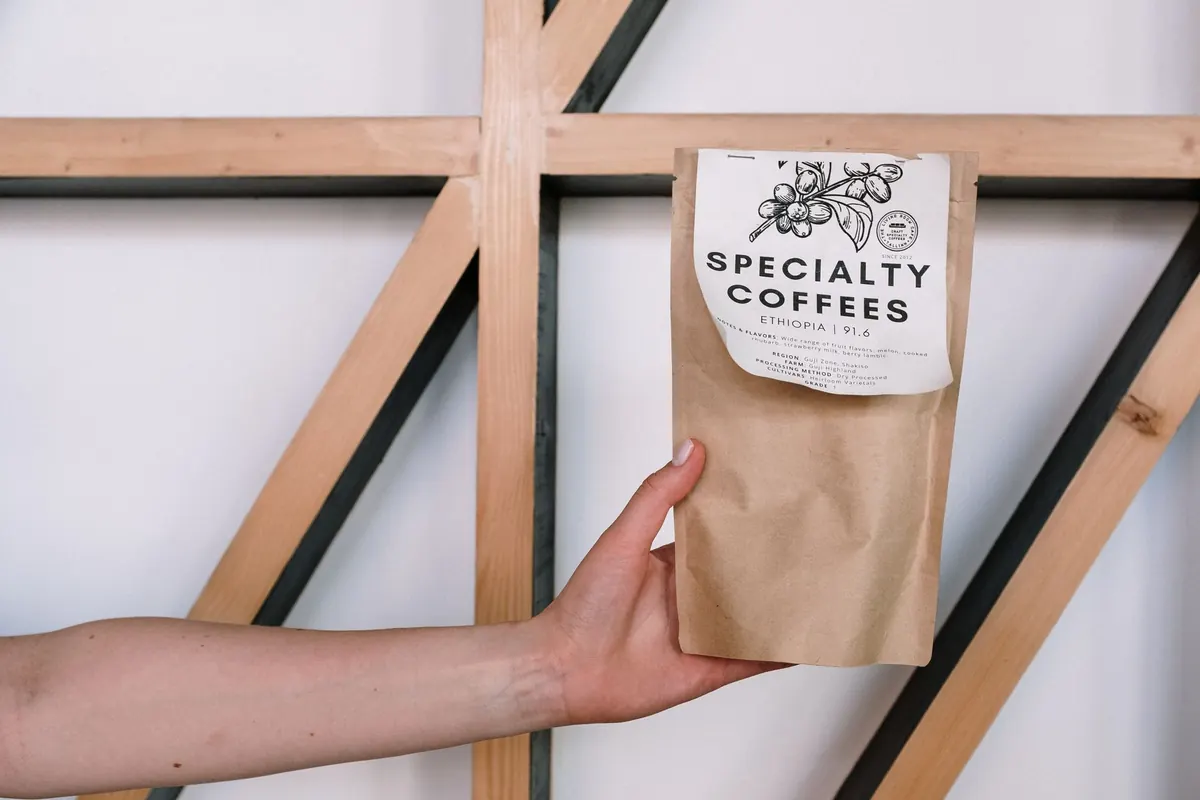
Pick up any bag of specialty coffee and you'll find a small block of text doing an enormous amount of work: a date, a country, a number followed by an "m", and a word like "washed" or "natural". Those four details tell you more about what's inside than the artwork, the medal stickers, or the paragraph about the roaster's trip to the farm. Learn to read them and buying coffee stops being a guess.
The Date That Actually Matters
Two dates can appear on a coffee bag: a roast date and a best-before date. Only one of them is useful.
A best-before date usually sits six to twelve months after roasting, which is long enough that it says almost nothing about how the coffee will taste this week. A roast date is specific, honest, and the single best indicator of freshness. If a bag carries no roast date at all, ask the shop when it was roasted. If nobody can tell you, that is your answer.
Coffee is not a dry good that improves with age. After roasting, beans release carbon dioxide for several days — the reason good bags have a one-way valve — and then slowly go stale. For filter coffee, most beans hit a sweet spot somewhere between five days and four weeks off roast. For espresso, a slightly longer rest often helps the shot settle, but the window is still measured in weeks, not months. Pre-ground coffee flattens faster because the surface area is far greater; buy whole bean and grind just before brewing when you can.
A bag with a best-before date more than a year out and no roast date is a bag telling you what it doesn't want you to know.
Origin: How Specific Does the Bag Get?
Country names are broad hints. Ethiopia often means floral, citrussy, tea-like cups. Brazil tends toward nuts and chocolate with low acidity. Kenya brings blackcurrant and a firm backbone of acidity. Colombia sits in the middle with caramel and red fruit. Sumatra can be earthy and heavy. Treat these as tendencies, not promises — one country can produce wildly different coffee.
The more specific the label, the better your chance of predicting the cup. "Ethiopia" is a start; "Ethiopia, Guji, Hambela, washed" gives you the region, the washing station or farm, and the process. Many roasters now print the producer's name, the village, the lot size, or the exact plot. That level of detail usually signals someone who bought carefully and knows what they're selling.
Blends deserve a fair hearing too. A well-built blend aims for consistency and balance and often costs less than a single-origin lot of similar quality. If the bag lists its components — say, 70 percent Brazil and 30 percent Ethiopia — you can still read it like a single origin and guess at the result.
Altitude: A Useful Clue, Not a Score
Somewhere in the small type you'll see a figure like 1,650 m or 1,900 masl, meaning metres above sea level. It is one of the quietest, most informative details on the bag.
Coffee grown high ripens slowly. The cherries spend longer on the tree, the beans inside grow denser, and denser beans tend to hold more sugar and acid — the raw material for the bright, layered cups many drinkers chase. Coffees from roughly 1,400 m and up are generally considered high-grown, and many prized lots sit between 1,700 and 2,100 m.
Two cautions. First, altitude is not a quality score: a 1,900 m coffee can be dull, and a 1,300 m coffee can be delicious if the variety, picking and processing are right. Second, the number means different things in different places. 1,600 m in Brazil is genuinely high; 1,600 m in Ethiopia is unremarkable. Read it alongside origin, not instead of it.
Process: The Word That Predicts Flavor
"Process" describes how the fruit was removed from the seed and how the seed was dried. It is the second-biggest lever on flavor after the coffee itself, and it is the term shoppers skip most often.
- Washed (wet-processed): the fruit is removed before drying. Clean, bright and transparent — you taste the coffee's acidity and its origin clearly.
- Natural (dry-processed): whole cherries are dried with the fruit still on. Heavier body, more sweetness, fruit-forward cups that can recall strawberry, blueberry or jam.
- Honey: the skin comes off but some sticky mucilage stays on during drying. Between the two — rounder than washed, tamer than natural.
- Anaerobic and experimental: beans fermented in sealed tanks, sometimes with fruit or cultured yeasts added. Expect intense aromatics — tropical fruit, spice, occasionally a boozy or savoury edge. Polarizing by design.
- Decaf: look for the method. Swiss Water and CO2 processes avoid chemical solvents, and both are widely available.
None of these is better than the others. If you want tea-like clarity, buy washed. If you want a coffee that tastes of berries, natural is the shortcut.
The Small Print: Varietal, Roast Level, Tasting Notes
Varietal names — Bourbon, Typica, Geisha, SL28, Pacamara, Caturra, and the heirloom landraces of Ethiopia — tell you what plant the seed came from. Geisha is famously aromatic, Bourbon tends sweet and round, SL28 in Kenya is the source of that blackcurrant note. It's the deepest layer of the label and worth learning slowly.
Roast level is less standardized than it looks. One roaster's "medium" is another's "light". As a rule, lighter roasts preserve origin character and acidity; darker roasts mute it and push toward bittersweet chocolate and smoke. Neither is a flaw, but the label rarely tells the whole story, so read the roaster's description of how it was developed.
Tasting notes are the roaster's impression of the cup, not a list of ingredients. "Peach and jasmine" does not mean anything was added. Two or three notes are a genuine guide to acidity and sweetness; twelve notes are marketing.
Certifications and claims — organic, Fairtrade, Rainforest Alliance, "direct trade" — vary in what they guarantee, and "direct trade" is not a regulated term. Treat them as one input, not a verdict.
A Sixty-Second Check in the Shop
- Find the roast date. Under four weeks old is good. No date at all: ask, and walk away if nobody knows.
- Read the origin from country down to farm or washing station. More detail usually means a more careful purchase.
- Note the process and match it to what you actually enjoy drinking.
- Check the altitude if it's printed. High-grown beans generally mean denser, brighter cups.
- Scan varietal and roast level. Light to medium protects origin character; dark is a choice, not a mistake.
- Ignore the poetry. A short flavor list is a map; a paragraph is advertising.
- Buy whole bean, in a bag with a one-way valve, in roughly the amount you'll drink within a month.
Once you know what these four details mean, the shelf gets a lot less confusing — and you'll spend less money finding coffee you genuinely like.
Photo: cottonbro studio / Pexels